Wednesday, 16 September 2015

WORD OF THE DAY : HUMILITY


Humility is defined by the English dictionary as the quality or condition of being humble; modest opinion or estimate of one's own importance, rank, etc.
Humility is something that is gained and practiced as we grow in wisdom and grace. Easton’s 1897 Bible Dictionary defines “humility” as: a prominent Christian grace. It is a state of mind well pleasing to God; it preserves the soul in tranquility and makes us patient under trials [1] Biblical speaking, humility is the opposite of pride.  And according to one the saurus source, some other antonyms for humility are: arrogance, assertiveness, egoism, pretentiousness, and self-importance.
Humility is the true key to success. Successful people lose their way at times. They often embrace and overindulge from the fruits of success. Humility halts this arrogance and self-indulging trap. Humble people share the credit and wealth, remaining focused and hungry to continue the journey of success.
The first test of a truly great man is his humility. By humility I don't mean doubt of his powers or hesitation in speaking his opinion, but merely an understanding of the relationship of what he can say and what he can do.
If we learn not Humility, we learn nothing and without Humility there is no humanity. Do you wish to rise? Begin by descending. You plan a tower that will pierce the clouds? Lay first the foundation of humility. Remember, with pride there are many curses but with humility there are a lot of blessings. Try Humility and enjoy all it entails.
 

Tuesday, 15 September 2015

RAIN (ACID RAIN AND ITS EFFECTS)

Rain is liquid water in the form of droplets that have condensed from atmospheric water vapor and become heavy enough to fall under gravity. Rain is a major component of the water cycle and is responsible for depositing most of the fresh water on the Earth. It provides suitable conditions for many types of ecosystems, as well as water for hydroelectric power plants and crop irrigation.
Acid Rain
Acid rain is rain consisting of water droplets that are unusually acidic because of atmospheric pollution - most notably the excessive amounts of sulfur and nitrogen released by cars and industrial processes. Acid rain is also called acid deposition because this term includes other forms of acidic precipitation such as snow. The chemicals in acid rain can cause paint to peel, corrosion of steel structures such as bridges, and erosion of stone statues.
Acidic deposition occurs in two ways: wet and dry. Wet deposition is any form of precipitation that removes acids from the atmosphere and deposits them on the Earth’s surface.
Dry deposition polluting particles and gases stick to the ground via dust and smoke in the absence of precipitation. This form of deposition is dangerous, however because precipitation can eventually wash pollutants into streams, lakes, and rivers.


Effects of Acid Rain
Aside from aquatic bodies, acid deposition can significantly impact forests. As acid rain falls on trees, it can make them lose their leaves, damage their bark, and stunt their growth. By damaging these parts of the tree, it makes them vulnerable to disease, extreme weather, and insects. Acid falling on a forest’s soil is also harmful because it disrupts soil nutrients, kills microorganisms in the soil, and can sometimes cause a calcium deficiency. Trees at high altitudes are also susceptible to problems induced by acidic cloud cover as the moisture in the clouds blankets them.

 Acid deposition also has an impact on architecture and art because of its ability to corrode certain materials. As acid lands on buildings (especially those constructed with limestone) it reacts with minerals in the stones sometimes causing it to disintegrate and wash away. Acid deposition can also corrode modern buildings, cars, railroad tracks, airplanes, steel bridges, and pipes above and below ground.

Saturday, 12 September 2015

HOW WELL CAN YOUR CHILD READ? – Reading is Fundamental


Reading with children and helping them practice specific reading components can dramatically improve their ability to read. Adults can help children learn to be good readers by assisting and teaching them  

 It has been said that “reading is fundamental.” If you think of the word fundamental as meaning “essential”, I would agree that this quote is correct. However, if you think of the word fundamental to mean “basic,” I would have difficulty agreeing with the quote. For most children, reading is fundamental in every aspect of the word. It is essential and necessary; it is also basic and elementary.
However, there is a percentage of children who do not fit the fundamental category.
 
Although reading is essential and necessary for everyone, there are children who find the task of reading and learning to read to be the most difficult thing that they have ever been asked to do. Children struggle with learning the letters of the alphabet, the sounds associated with the letters, and the ability to put those letters and sounds together to read and make words.

When children begin the reading process frustrated and feeling incapable, they may also experience vulnerability and fear. These are feelings that should not be associated with the process of learning.
That’s why it’s important to know whether your child is a successful reader or a struggling reader, and expose him to as much reading material as possible. One way to get an idea of your child’s reading ability is to ask him to read. If he’s past first grade, he should be able to read with fluency and tell you what he’s read. If it appears that your child is calling word, mispronouncing words that reappear, taking time to sound out sight words, or shows signs of frustration, you should express your concerns to the teacher.


Exposing your child to print material should begin at an early age, and you should observe how he responds to it. You can use flash cards, picture and word books, or books that repeat the same words over and over. Labeling items around the house is also a good method to use.

Monday, 7 September 2015


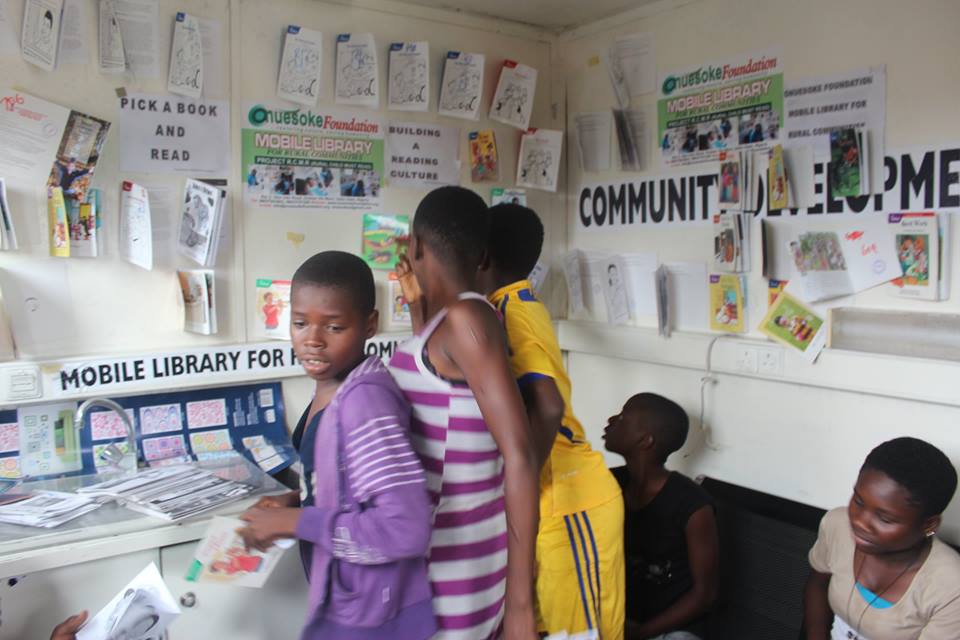
ONUESOKE FOUNDATION MOBILE LIBRARY PRESENTS
PUBLIC READING DAY

IT IS LITERACY DAY......HOW  MANY PEOPLE CAN READ IN OUR SOCIETY?
OUR MOBILE LIBRARY WILL BE LANDING AT ORUNWHONRUN JUNCTION NEAR JUBGBALE MARKET ON TUESDAY 8th SEPTEMBER
 ...PICK A BOOK AND READ
BRING SOME ONE ALONG AND READ A STORY TO THE PERSON


CLIMATE CHANGE AS IT AFFECTS THE HEALTH OF HUMANS

Climate variability and change threaten human health and well being. Changes in the greenhouse gas concentrations and other drivers alter the global climate and bring about myriad human health consequences. Environmental consequences of climate change, such as extreme heat waves, rising sea-levels, changes in precipitation resulting in  flooding and droughts, intense hurricanes, and degraded air quality, affect directly and indirectly the physical, social, and psychological health of humans.  For instance, changes in precipitation are creating changes in the availability and quantity of water, as well as resulting in extreme weather events such as intense hurricanes and flooding.  Climate change can be a driver of disease migration, as well as exacerbate health effects resulting from the release of toxic air pollutants in vulnerable populations such as children, the elderly, and those with asthma or cardiovascular disease. 
                  Certain adverse health effects can be minimized or avoided with sound mitigation and adaptation strategies. Strategies for mitigating and adapting to climate change can prevent illness and death in people now, while also protecting the environment and health of future generations.  Mitigation refers to actions being taken to reduce greenhouse gas emissions and to enhance the sinks that trap or remove carbon from the atmosphere. Adaptation refers to actions being taken to lessen the impact on health and the environment due to changes that cannot be prevented through mitigation. Appropriate mitigation and adaptation strategies will positively affect both climate change and the environment, and thereby positively affect human health. Some adaptation activities will directly improve human health through changes in our public health and health care infrastructure.
It is critical that adaptation and mitigation decisions and policies be developed with a sound basis in the best current science on climate change and its effects. There are gaps in our understanding of the relationship between climate change, the environment, and human health. In its 2010 report, A Human Health Perspective on Climate Change (Full Report) , the NIEHS-led Inter agency Working Group on Climate Change and Health identified major research areas that need to be further explored and understood. These include the following:
·         Asthma, Respiratory Allergies, and Airway Diseases
·         Cancer
·         Cardiovascular Disease and Stroke
·         Food borne Disease and Nutrition
·         Heat-Related Morbidity and Mortality
·         Human Developmental Effects
·         Mental Health and Stress-Related Disorders
·         Neurological Diseases and Disorders
·         Vector borne  and  Zoonotic Diseases 
·         Waterborne Disease
·   Weather-Related Morbidity and Mortality